
How to Reduce Candidate Drop-Off by 40%: Lessons From 1,000+ Simulations
60 to 80 percent of candidates abandon hiring assessments before completing them. Here is why it happens and exactly what keeps top talent engaged all the way through.
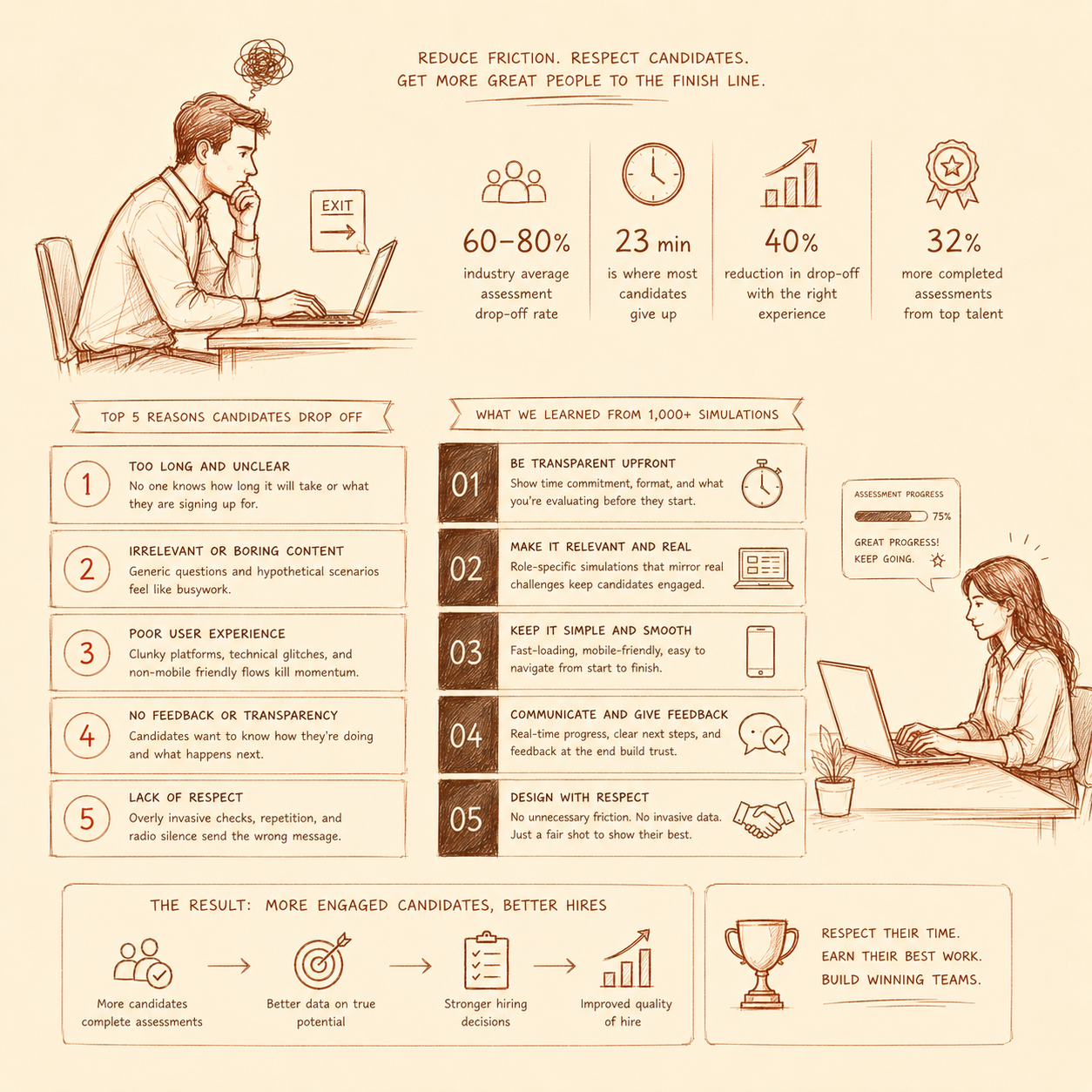
The best candidates are not the ones who apply to every job they see. They are selective, busy, and if they are genuinely talented, already employed. When they engage with your hiring process, they are making a series of small judgment calls about whether your organisation is worth their time. Each friction point, each impersonal touchpoint, each request that feels invasive is another reason for them to quietly close the tab and go back to their current role.
The industry average for candidate abandonment during assessment stages sits at 60 to 80 percent. That means for every ten qualified candidates you send an assessment to, six to eight of them will never complete it. And the ones who drop off are not distributed evenly across talent quality. The best candidates, the ones with the most options and the strongest professional confidence, leave fastest.
After processing over 1,000 candidate sessions across enterprise pilots with organisations including Microsoft, Booking.com, Rabobank, and Cognizant, we have learned a lot about why candidates drop off and what genuinely keeps them engaged. This post shares what the data showed us.
Abandonment
60-80%
of candidates abandon assessments before completing them
With value
40%
reduction in drop-off when assessments return value to the candidate
Sweet spot
10 min
is the sweet spot for high-signal, low-friction assessments
Top talent
Drops off first
when surveillance or impersonal formats are used
The Abandonment Crisis Nobody Talks About
Hiring teams track time-to-hire. They track cost-per-hire. They track offer acceptance rates. Almost nobody tracks assessment abandonment rates. And when they do, they rarely share the numbers internally because they are embarrassing.
Think about what the standard corporate assessment experience looks like in 2026. A candidate receives a calendar invite or a link after a phone screen. They are asked to complete a 45 to 60 minute psychometric battery. They are told a webcam will be running during the process. They are not told what the assessment measures, how it is scored, or what will happen to their data. They receive no personalised output at the end. Then they wait five to ten business days to hear whether they passed.
It is a thoroughly impersonal experience. And top candidates, the ones with enough market value to be genuinely selective, exit this experience faster than anyone else. The 60 to 80 percent abandonment rate is not spread evenly across talent quality. It skews heavily toward the best people in any applicant pool.
The candidates who complete these assessments are often the ones with the fewest other options. Which means your selection pool is already filtered in exactly the wrong direction before a single result has been reviewed.
Your abandonment rate is not just a candidate experience problem. It is a data quality problem. The people most likely to drop off are the people most worth hiring.
The Five Friction Points That Drive Candidates Away
Our analysis of drop-off patterns across the Valentiq pilot cohort identified five primary reasons candidates abandon assessments. Each one is fixable.
Length and perceived irrelevance
Candidates will invest time in an assessment if they believe it is measuring something real and connected to the actual role. They will not spend 60 minutes on abstract pattern recognition questions that appear to have no relationship to the work they would be doing. Generic assessments that feel like they could apply to any company in any industry signal that the organisation has not thought carefully about what good actually looks like for this specific job.
Surveillance and monitoring
The moment a candidate is told their webcam will record their facial expressions, their eye movements will be tracked, or their keystrokes will be logged, a significant number of them make an immediate decision about the organisation's culture. That decision is usually not favourable, and may conflict with EU AI Act rules. This effect is strongest among exactly the candidates you most want: senior professionals with substantial market alternatives and strong views on privacy.
Zero value returned to the candidate
Traditional assessments take data from candidates and return nothing. The candidate spends 45 minutes answering questions. The organisation gets usable data. The candidate gets a waiting period and eventually either silence or a rejection. This asymmetry feels disrespectful to many candidates, particularly senior ones who are used to being courted rather than processed.
Poor mobile and interface experience
A growing share of candidates encounter assessment links on mobile devices during a commute or between meetings. Legacy assessment platforms were not built for mobile. They render poorly, require desktop file uploads, or break entirely on smaller screens. A candidate who hits a broken interface on their phone rarely circles back to complete it on a laptop later.
No transparency about the process or scoring
"We will be in touch" is not a process. Candidates who do not know how the assessment will be scored, how their data will be used, or when they will hear back experience uncertainty that converts quickly to disengagement. Transparency about the process signals something important: it tells the candidate that this organisation operates with respect for the people it is evaluating.
What Our Data Shows Actually Works
Here are the five findings from our simulation data that had the biggest impact on completion rates and engagement quality.
Ten minutes of high fidelity beats 45 minutes of generic
Our platform delivers scenarios in under 10 minutes. Not because shorter is always better, but because a well-designed 10-minute scenario that genuinely mirrors the real role generates more predictive signal than a 45-minute abstract battery. When candidates encounter a scenario that feels like actual work they would do in the job, their engagement increases sharply. They stop completing a test and start doing the work. That distinction matters profoundly to how they experience the assessment and to the quality of data it generates.
Result: Completion rates consistently exceeded industry benchmarks across all pilot clients
The reciprocal value exchange changes everything
The single most impactful change we made to the candidate experience was introducing an immediate, personalised professional diagnostic report delivered the moment the simulation is completed. Every candidate who finishes a Valentiq simulation receives a detailed breakdown of their operational profile within seconds: their decision-making velocity, async communication style, risk-mitigation orientation, and how their profile compares to high performers in similar roles. This transforms the experience from extraction to exchange.
Result: Completion rates increased. Sharing rates increased. Candidate referrals to peer hiring managers became one of our strongest acquisition channels.
Zero surveillance is a feature, not a constraint
Removing all biometric and monitoring data collection from our platform was originally a compliance and privacy decision. It turned out to also be a candidate experience decision. Candidates who are told explicitly that no video, audio, or behavioural telemetry will be collected respond with higher engagement and more authentic behaviour during the simulation. When people know they are not being watched, they make the choices they would actually make in a real operational situation, not the choices they think will look best to an observer.
Result: More authentic choices. More predictive data. Better hiring decisions downstream.
Mobile-first matters for passive senior talent
Senior candidates who are not actively job hunting are most likely to encounter your assessment link on a mobile device, during a commute or in between meetings. Our simulation interface was designed from the ground up to be fully functional on mobile. No file uploads. No webcam dependency. No desktop-specific layout that collapses on a phone screen.
Result: Senior passive candidates completed at rates well above the industry benchmark for their profile.
Transparency before the assessment starts reduces early abandonment sharply
Candidates who receive a clear, plain-language explanation of how the assessment works, what it measures, and what will happen to their data before they begin show significantly lower early abandonment rates. The content of the explanation matters less than its existence. Transparency is the signal. It tells the candidate that this organisation operates with respect for the people it is evaluating, which for most thoughtful candidates is an early proxy for how the organisation treats its employees.
Result: Early abandonment (candidates who quit in the first two minutes) dropped substantially with pre-assessment transparency.
The Feedback Loop Most Organisations Miss
There is a feedback loop here that most organisations do not see until it is pointed out.
When candidates feel respected, they engage more authentically. When they engage more authentically, the behavioural data generated by their choices is more accurate. When the data is more accurate, the hiring decision is better. When the hiring decision is better, the new hire is more likely to succeed, stay, and perform.
Candidate experience is not a courtesy. It is a data quality mechanism.
The organisations that have redesigned their candidate experience, not by making assessments easier but by making them more respectful and more reciprocal, consistently report better quality-of-hire metrics downstream. Not because they lowered the bar. Because they attracted and kept better candidates through the assessment stage.
Worth noting: A candidate who drops off your assessment is not just a missed hire. They are someone who will talk to their network about the experience. In tight professional communities, a reputation for surveillance-heavy or impersonal hiring processes spreads faster than any employer branding campaign can counteract it.
A Practical Checklist for Your Current Assessment Process
If you are reviewing what you currently use, here are five honest questions to ask.
Does your assessment take under 15 minutes for a high-signal first stage?
If not, what is the evidence that the additional time generates proportionally more predictive signal? Longer is not more rigorous. It is often just more friction.
Does your assessment return something of value to the candidate upon completion?
If not, what incentive does a strong candidate have to complete it? And what does that say to them about how your organisation treats its people?
Does your assessment involve any form of monitoring, webcam recording, or biometric data collection?
If so, what is your legal basis under GDPR? What is your EU AI Act compliance posture? And what is it costing you in drop-off among your strongest candidates?
Is your assessment fully functional on mobile?
If not, you are losing the most selectively engaged senior candidates at the very first screen, before they have seen a single question.
Do candidates understand, before they begin, how they will be scored and when they will hear back?
If not, what does that silence tell them about how your organisation communicates? First impressions in hiring cut both ways.
How Drop-Off Rate and Hire Quality Are Connected
One thing our data made very clear: candidate drop-off is not a passive leak. It is an active filter that systematically removes the candidates with the most options from your pipeline.
| Assessment Experience | Who Drops Off | What Remains in Pool | Downstream Quality |
|---|---|---|---|
| Long, generic, surveillance-based | Senior and passive candidates with options | Candidates with fewer alternatives | Lower quality-of-hire scores |
| No reciprocal value, no transparency | Professionals who feel their time matters | Candidates who need the job more than they want it | Higher early attrition |
| Short, role-specific, value-returning | Very low drop-off across all profiles | Full talent pool including top performers | Significantly better hire quality and retention (see 90-day retention) |
The Bottom Line
Candidate drop-off is one of the most expensive and least discussed problems in talent acquisition. The 60 to 80 percent abandonment rate is not a fixed feature of the hiring market. It is what happens when organisations treat assessment as something they do to candidates rather than something they do with them.
Fixing it does not require a large investment. It requires a shift in orientation. Shorter, more relevant assessments. Zero surveillance. A real output for the candidate at the end. Transparency about the process from the start. A mobile-first interface that works for people who are busy and not sitting at a desk waiting for you.
Make those changes and the candidates who matter most stop dropping off. The data you collect becomes more accurate because the people generating it are more engaged. And the hiring decisions you make get better as a direct result.
The best candidates are not obligated to stick around for a bad assessment experience. But they will stick around for a good one.
See what a candidate experience worth completing looks like
Valentiq's work simulation platform is built around the principle that candidate experience and assessment quality are the same variable, not a trade-off. Zero surveillance. Personalised diagnostic output for every candidate. EU AI Act compliant. Mobile-first by design.
Book a demo →Agentic hiring simulations for operational-fit decisions.
See a demo →